A single car accident can wipe out years of careful budgeting. Yet many drivers still buy auto insurance without fully understanding what they’re paying for. The confusion usually starts with one question: Do I need comprehensive coverage, collision coverage, or both?
The answer isn’t as straightforward as most insurance advertisements make it sound.
While both cover damage to your vehicle, they protect against entirely different risks. Choosing the wrong option can leave you paying thousands of dollars out of pocket—or paying premiums for protection you no longer need.
This guide breaks down the real differences between comprehensive and collision insurance, when each coverage makes financial sense, and how experienced drivers reduce insurance costs without sacrificing meaningful protection.
Understanding the Foundation of Physical Damage Coverage
Liability insurance pays for damage you cause to other people or their property. It doesn’t repair your own vehicle.
That’s where physical damage coverage comes in. It consists of two separate policies:
- Comprehensive Insurance
- Collision Insurance
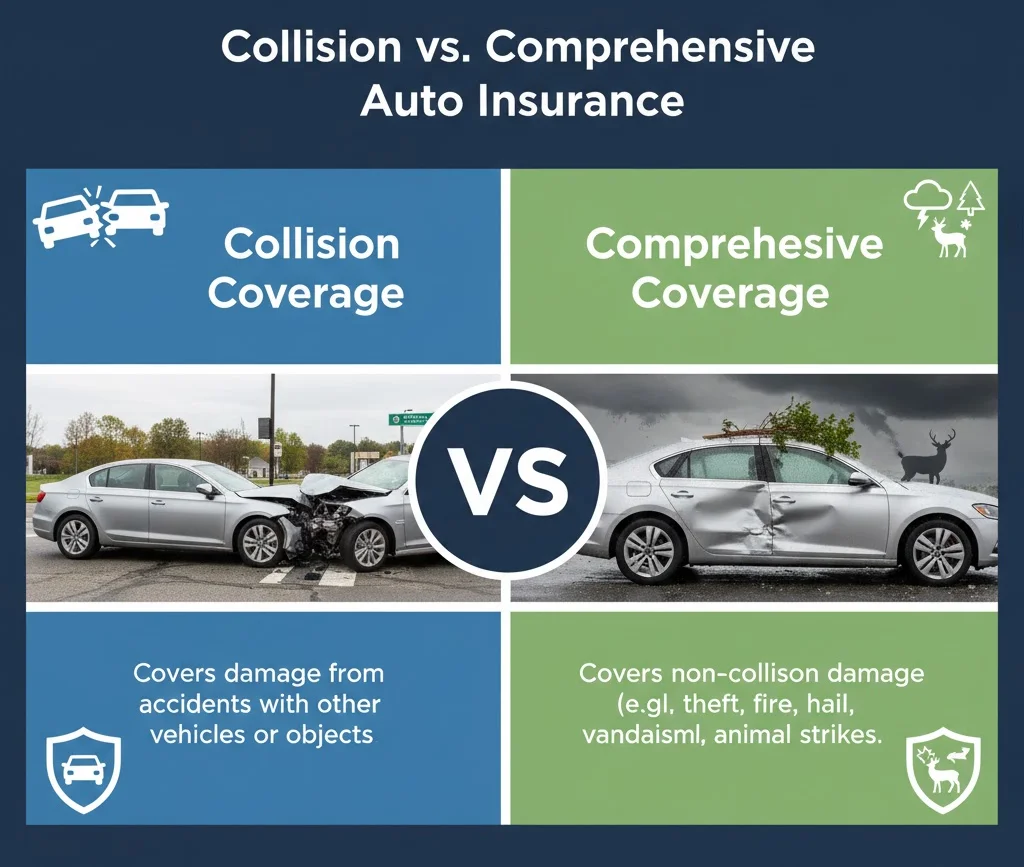
Most people purchase both together, but they function independently. One covers accidents involving your vehicle, while the other protects against unexpected events that happen outside of driving collisions.
Knowing exactly where each policy applies is the difference between filing a successful claim and discovering an expensive gap in your coverage.
What Is Collision Insurance?
Collision insurance pays to repair or replace your vehicle after it collides with another object, regardless of who caused the accident.
The object doesn’t have to be another car.
Your insurer generally covers repairs if your vehicle hits:
- Another automobile
- A pickup truck or SUV
- A motorcycle
- A utility pole
- A concrete barrier
- A guardrail
- A fence
- A tree
- A building
- A pothole severe enough to cause major damage
- An embankment after losing control
Single-vehicle accidents are surprisingly common. Sliding on wet pavement, backing into a concrete pillar, or hitting a parking garage wall all fall under collision coverage.
Typical Collision Insurance Claims
Imagine these situations:
A distracted driver rear-ends another vehicle at a traffic light.
A new driver misjudges a parking space and scrapes a concrete column.
A vehicle hydroplanes during heavy rain and strikes a highway barrier.
Someone swerves to avoid traffic and crashes into a roadside tree.
Every one of these scenarios generally falls under collision insurance.
If repairs exceed the vehicle’s actual cash value (ACV), the insurer may declare it a total loss and compensate you based on market value, minus your deductible.
Reference: [Insert Authority Link Here: Insurance Information Institute – Collision Coverage]
What Is Comprehensive Insurance?
Comprehensive insurance covers damage caused by events other than collisions.
Think of it as protection against the unexpected.
Many drivers call it “acts of nature” coverage, but it extends well beyond weather-related incidents.
Comprehensive Insurance Typically Covers
Weather Events
- Hail
- Flooding
- Windstorms
- Hurricanes
- Tornadoes
- Lightning
Natural Hazards
- Falling tree branches
- Rockslides
- Flying debris
- Earthquakes (where applicable)
Crime
- Vehicle theft
- Attempted theft
- Vandalism
- Broken locks
- Key damage after theft
Fire Damage
Engine fires, garage fires, wildfire damage, and accidental fires may all qualify.
Animal Collisions
One exception often surprises drivers.
Hitting another vehicle is a collision claim.
Hitting a deer, elk, cow, or similar animal usually becomes a comprehensive claim, even though your car physically collided with something.
Broken Windshields
Many insurers include windshield repairs or replacement under comprehensive coverage, sometimes with separate deductible rules depending on state regulations.
Examples of Comprehensive Claims
Your parked vehicle is crushed by a falling tree during a storm.
Someone steals your SUV overnight.
Golf-ball-sized hail destroys your hood and roof.
A wildfire spreads into your neighborhood.
A deer jumps across the highway and damages your front bumper.
Someone smashes your windows while attempting to steal items from inside.
These incidents have one thing in common.
They weren’t caused by a collision with another moving vehicle or object while driving.
Reference: [Insert Authority Link Here: National Association of Insurance Commissioners – Auto Insurance Consumer Guide]
Comprehensive vs Collision Insurance at a Glance
| Feature | Comprehensive Insurance | Collision Insurance |
|---|---|---|
| Covers vehicle accidents | No | Yes |
| Covers hitting another car | No | Yes |
| Covers hitting a tree while driving | No | Yes |
| Covers falling tree damage | Yes | No |
| Covers theft | Yes | No |
| Covers vandalism | Yes | No |
| Covers fire | Yes | No |
| Covers hail damage | Yes | No |
| Covers floods | Yes | No |
| Covers animal collisions | Yes | No (in most cases) |
| Covers rollovers after an accident | No | Yes |
| Usually requires deductible | Yes | Yes |
| Required by state law | No | No |
| Often required by lenders | Yes | Yes |
The Biggest Misconception Drivers Make
Many people assume comprehensive insurance means “full coverage.”
It doesn’t.
There is actually no legal insurance policy called full coverage.
When insurance agents use that phrase, they’re usually referring to a package that combines:
- Liability insurance
- Collision insurance
- Comprehensive insurance
- Sometimes uninsured or underinsured motorist coverage
- Medical payments or personal injury protection where required
The exact combination varies by insurer and state.
This misunderstanding leads some drivers to believe every type of damage is automatically covered. Then an accident happens, and they discover exclusions they never expected.
Reference: [Insert Authority Link Here: Consumer Reports – Understanding Auto Insurance]
Which Coverage Costs More?
In most markets, collision insurance costs noticeably more than comprehensive insurance.
Why?
Collision claims happen far more often.
Minor parking accidents, rear-end crashes, side-swipes, and single-car collisions generate billions of dollars in claims every year.
Comprehensive claims, while sometimes severe, occur less frequently.
Insurance companies price policies based on risk probability, claim frequency, repair costs, and historical loss data.
Typical pricing is influenced by:
- Driver age
- Driving record
- Vehicle value
- ZIP code
- Theft rates
- Repair costs
- Annual mileage
- Deductible selection
- Credit-based insurance score (where legally permitted)
A newer luxury SUV driven in a dense urban area will almost always carry higher collision premiums than a ten-year-old compact sedan parked in a suburban garage.
How Deductibles Affect Both Coverages
Both comprehensive and collision insurance typically include separate deductibles.
A deductible is the amount you pay before your insurance company contributes toward repairs.
Here’s a simple example:
- Collision deductible: $1,000
- Repair estimate: $6,500
- Insurance payout: $5,500
The same concept applies to comprehensive claims.
If hail causes $3,000 in damage and your comprehensive deductible is $500, you’ll pay the first $500, while your insurer covers the remaining eligible repair costs.
Choosing a higher deductible often lowers monthly premiums, but it also increases your out-of-pocket expense after a claim.
Experienced drivers usually select deductibles they could comfortably pay without relying on credit cards or emergency loans.
When Does It Make Sense to Carry Both Coverages?
For many drivers, the answer is simple: if your vehicle would be expensive to repair or replace, carrying both comprehensive and collision insurance is usually the safer financial decision.
That doesn’t mean every car needs both.
Think about your vehicle’s actual cash value (ACV) rather than what you originally paid for it. Insurance companies settle total-loss claims based on current market value after depreciation—not the purchase price.
As a rule of thumb, keeping both coverages often makes sense if:
- Your vehicle is relatively new.
- You couldn’t comfortably replace it out of pocket.
- You have an auto loan or lease.
- Repair parts are expensive or difficult to source.
- You regularly drive in high-traffic areas where accident risk is greater.
If losing the vehicle tomorrow would create a serious financial setback, dropping physical damage coverage to save a few dollars each month may not be worth the risk.
When Might You Drop Collision Coverage?
There comes a point where collision insurance provides diminishing value.
Suppose your car is worth $3,500, your collision deductible is $1,000, and your annual collision premium is $700.
If the vehicle is totaled, the maximum payout would roughly be:
- Vehicle value: $3,500
- Less deductible: $1,000
- Estimated insurance payment: $2,500
Now compare that to paying $700 every year in premiums.
After several years, you’ve paid a significant percentage of the car’s value just to maintain coverage.
Many financial planners suggest reviewing collision insurance when:
- The vehicle’s market value falls below several thousand dollars.
- Annual premiums become a large percentage of the car’s value.
- You have enough savings to replace the vehicle yourself.
There isn’t a universal cutoff. The right decision depends on your finances, driving habits, and risk tolerance.
Should You Ever Drop Comprehensive Coverage?
Comprehensive insurance is often much cheaper than collision insurance.
Because of that, many drivers choose to keep comprehensive even after removing collision coverage.
Why?
Unexpected events don’t stop because a car gets older.
Older vehicles are still stolen.
Trees still fall.
Storms still happen.
Windshields still crack.
If comprehensive coverage costs only a modest amount each year, keeping it may provide worthwhile protection against losses that are difficult to predict.
Lender and Lease Requirements
If your vehicle is financed, your decision may already be made.
Most banks, credit unions, and leasing companies require both comprehensive and collision coverage until the loan is paid in full.
Their reasoning is straightforward.
The lender still has a financial interest in the vehicle. If it’s totaled, they want assurance that the remaining loan balance can be recovered.
Failing to maintain required coverage can lead to force-placed insurance, where the lender purchases insurance on your behalf.
That policy is often:
- More expensive
- Less comprehensive
- Added directly to your loan balance
Always review your financing agreement before canceling either coverage.
Real-World Scenarios
Sometimes examples explain insurance better than definitions.
Scenario 1: Shopping Center Accident
You back into a concrete pillar while leaving a parking garage.
Covered by: Collision insurance
Scenario 2: Overnight Theft
Your SUV disappears from your driveway.
Covered by: Comprehensive insurance
Scenario 3: Deer Crossing
A deer runs into your lane at highway speed.
Covered by: Comprehensive insurance
Scenario 4: Rear-End Collision
Another driver crashes into your vehicle.
If they are insured and accept liability, their property damage liability coverage typically pays.
If they are uninsured, underinsured, or fault cannot immediately be determined, your collision coverage may pay first, subject to your deductible.
Scenario 5: Hailstorm
Large hail dents your roof, hood, and trunk.
Covered by: Comprehensive insurance
Scenario 6: Sliding on Ice
You lose control during winter weather and hit a guardrail.
Covered by: Collision insurance
Factors Insurance Companies Consider When Pricing These Coverages
Premiums aren’t calculated randomly. Insurers rely on large datasets, predictive modeling, and historical claim trends.
Common rating factors include:
- Vehicle make and model
- Repair costs for replacement parts
- Local theft statistics
- Population density
- Weather risks
- Driver age and experience
- Previous claims
- Annual mileage
- Garaging location
- Selected deductible
- Safety technology such as automatic emergency braking or lane-keeping assistance
Vehicles with expensive sensors, cameras, and advanced driver-assistance systems can cost substantially more to repair after even a minor collision, which often increases collision premiums.
How to Lower Your Premium Without Sacrificing Protection
Instead of removing valuable coverage, look for ways to reduce the overall cost of your policy.
Consider these strategies:
- Increase your deductible if you have adequate emergency savings.
- Bundle auto and home insurance with the same insurer.
- Ask about safe-driver discounts.
- Install approved anti-theft devices.
- Drive fewer miles if you qualify for low-mileage programs.
- Compare quotes at least once a year.
- Review optional coverages you may no longer need.
A policy review every 12 months often uncovers savings that have nothing to do with reducing protection.
Common Mistakes Drivers Make
Avoiding these mistakes can save both money and frustration when filing a claim.
Keeping unnecessary coverage on a low-value vehicle
Paying high premiums for a car worth very little rarely provides good long-term value.
Choosing the lowest deductible without doing the math
Lower deductibles increase premiums. Sometimes the difference isn’t financially worthwhile.
Assuming “full coverage” means everything is covered
Insurance policies contain exclusions, limits, and conditions. Reading the policy matters.
Ignoring vehicle depreciation
Coverage decisions should reflect today’s market value, not what the vehicle cost years ago.
Never comparing insurers
Pricing varies dramatically between companies, even for identical drivers with the same vehicle.
The Verdict
Comprehensive and collision insurance solve different problems. One protects against accidents involving your vehicle while driving. The other covers many of the unpredictable events that can damage or destroy your car when no collision is involved.
The smartest choice isn’t simply buying both—or dropping one to reduce your premium. It’s matching your coverage to your vehicle’s value, your financial situation, and the level of risk you’re prepared to absorb yourself.
As your car ages, revisit the numbers. Compare the annual premium, deductible, and current market value. That quick review can reveal whether you’re still getting meaningful protection or paying for coverage that no longer fits your needs.
For accurate guidance on policy requirements and consumer protections, consult [Insert Authority Link Here: Insurance Information Institute], [Insert Authority Link Here: National Association of Insurance Commissioners], [Insert Authority Link Here: Consumer Financial Protection Bureau], or your state’s insurance department.
Frequently Asked Questions
1. Is comprehensive insurance required by law?
No. State laws generally require liability insurance, not comprehensive coverage. However, lenders and leasing companies commonly require comprehensive and collision insurance until the vehicle is paid off.
2. Does collision insurance cover hitting a pothole?
Yes, in many cases. If striking a pothole causes damage to your vehicle, collision coverage may apply, subject to your deductible and policy terms.
3. If I hit a deer, is that collision or comprehensive?
Despite the name, collisions with deer and many other animals are typically covered under comprehensive insurance, not collision coverage.
4. Can I buy comprehensive insurance without collision insurance?
Yes. Most insurers allow you to purchase comprehensive coverage by itself, provided there are no lender or lease requirements preventing it.
5. How often should I review whether I still need collision coverage?
Review your policy at least once a year or whenever your vehicle’s market value changes significantly. If the cost of maintaining collision coverage approaches the value of the vehicle or exceeds the benefit you could realistically receive after a deductible, it may be time to reassess your coverage.